


As temperatures cool a bit and some rain returns out in the western U.S., we’re shifting our attention from the urgency of wildfires (although the fire season continues until November) to planning for the long-term. Monsoon season petrichor inspires dreams of mud cities. Despite code officials’ resistance, earthen construction offers a lot, such as increased fire resistance and decreased carbon emitted during construction. This month we’re thinking about the potential and how to spread these methods across the country. Don’t worry about us getting carried away with distant hopes: there’s a decent amount of political and climate weirding news to keep us grounded.
ECO-TECHNICS
Podcast: Building Resilience - The Future of Adobe in Fire-Prone Areas

This podcast episode features a fascinating interview with earth building leader Ben Loescher. Over the course of a conversation, Loescher explains why he thinks adobe and earthen construction are one of the best ways to rebuild in fire-prone areas: it dampens the intensity of wildfires and urban fires, and the intensity of having to burn a lot of carbon to create building materials such as concrete. He also mentions what kinds of things need to change in building codes to remove barriers to better, safer buildings.
ECO-TECHNICS
From the Magazine: Community College Dreams
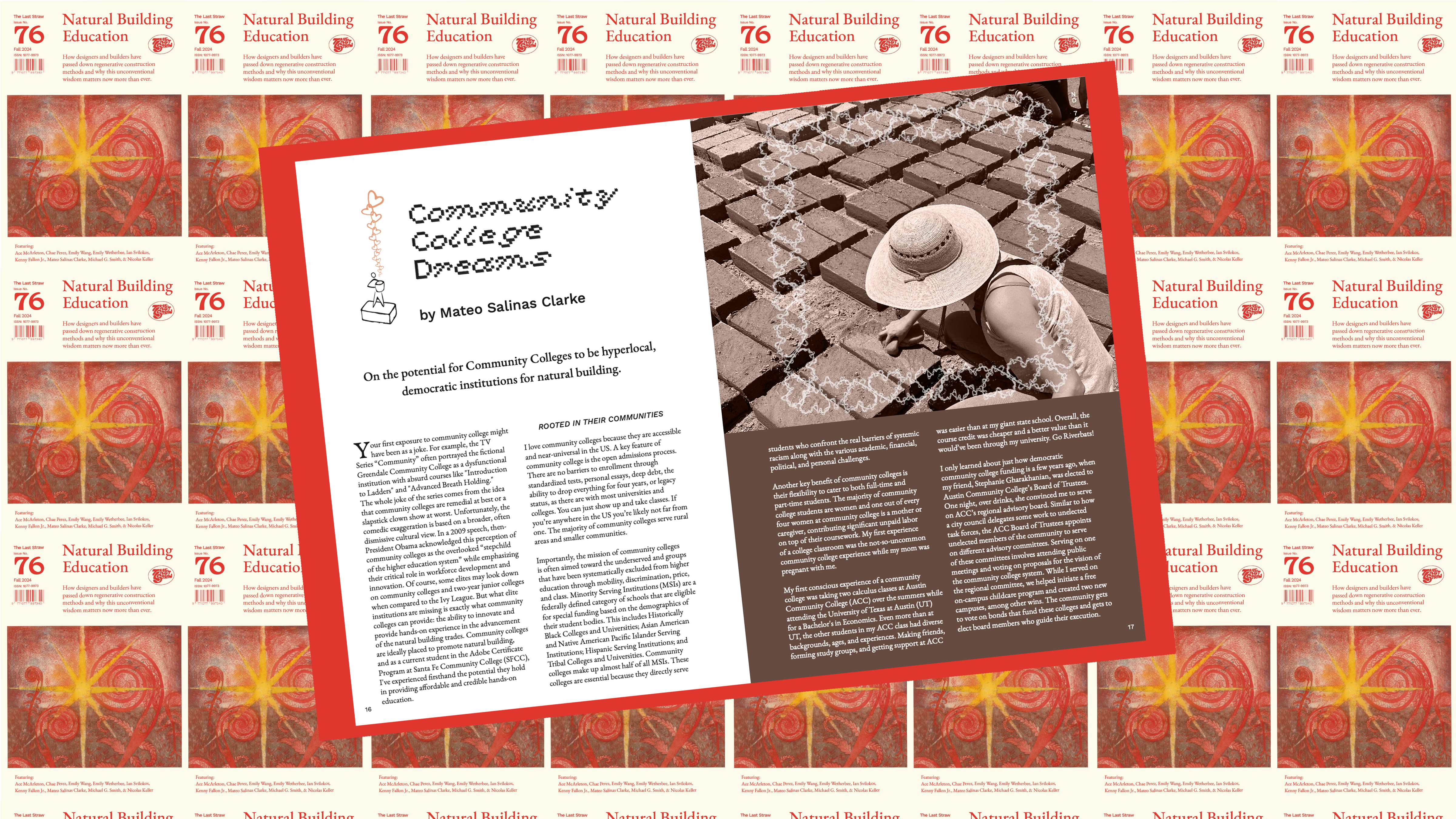
Are you fired up about earthen building after that interview?! If so, check out this article from The Last Straw Issue No. 76 all about Sante Fe Community College’s adobe building program. In addition to describing the structure of the program, author Mateo Salinas Clarke issues a call to action to participate at your local affordable community college: they may hold one of the keys to expanding regenerative building knowledge and practice.
FIELD NOTES
Domaine de Beaucastel

A historical bio-dyanamic vineyard gained some newer buildings designed by Studio Mumbai and Studio Méditerranée, “primarily made from the earth excavated, compressed and relocated in a balance of cut and fill”. The new complex also makes use of rainwater reuse and a passive ventilation system to cool underground wine cellars.
FIELD NOTES
Leaders promised to cut climate pollution, then doubled down on fossil fuels while Trump called climate change a ‘con job’ at the United Nation

While we’ve previously shared research that Paris Agreement greenhouse gas reduction goals are no longer possible given the lack of progress, the Stockholm Environment Institute’s 2025 Production Gap Report actually shows that “the 20 most polluting countries, including China, the U.S. and India, actually plan to produce even more fossil fuels than they did two years ago, when the report was last updated.” This news comes at the same time Trump tells the United Nations “This ‘climate change,’ it’s the greatest con job ever perpetrated on the world, in my opinion”. PBS has shown how hollow his claims ring here, but in many ways his words are merely the latest attempt to cover over an agreement that international leaders never intended to follow. As always, it’s up to the global majority to fight for a livable world.
BIOSPHERICS
Video: The Demolition Drama

This half-hour video explores the massive carbon-reducing potential of prioritizing building renovation over demolition. Architects from Herzog & de Meuron and Lacaton & Vassal join a growing chorus of practitioners that unpack what it might mean to value buildings as places for people to live over buildings as speculative financial objects.
BIOSPHERICS
As Land Used for Agriculture Shrinks, Building with Biomass Might Offer New Rural Futures

This article highlights an unexpected trend: even as world population grows, the amount of land used for agriculture has decreased. Many reasons are offered: more efficient farming technology, the rise of lab-grown meat, and the replacement of natural materials with synthetic, often oil-based, alternatives. Sometimes this allows areas to become wild again, but often this land becomes timber plantations (essentially monocrop forests with little biodiversity and less carbon storage than healthy forests). The decline of fossil fuel-intensive monocropping is a step in the right direction, but is not nearly enough to mitigate the ecological crises.
A report from earlier this year explores how we might go further in capturing carbon in buildings with materials we can grow. RMI’s “Harnessing Carbon Removal Opportunities in Biomass Residue Building Products” report shows just how much existing waste biomass can supply our building needs. What’s more is that building with rapidly renewable grasses would cycle more carbon into the ground and buildings without abandoning the rural places already suffering from the consolidation and optimization of agriculture.
BIOSPHERICS
New Hybrid Bird Created by Climate Change Discovered in Texas

Two bird species, the Blue Jay and the Green Jay, might now be interacting for the first time in millions of years as climate change pushes their ranges to overlap near San Antonio, Texas. That’s where a scientist found the first wild “Grue Jay” after being tipped off by a hobbyist birding group and studying it long enough to learn its true nature. Hybrid species will likely become more common as climates change more rapidly, underscoring the importance of everyone keeping an eye out as we all try to adapt.
We hope you stay grounded in good communities this October, maybe with mud between your toes. If you ever find yourself near London (U.K.), San Francisco (CA), or Green River (UT) let us know and let’s meet up!
See ya next month,
The Last Straw Editorial Collective
DON’T MISS OUT, GET OUR LATEST MAGAZINE NOW!
The Last Straw Issue 76, on Natural Building Education
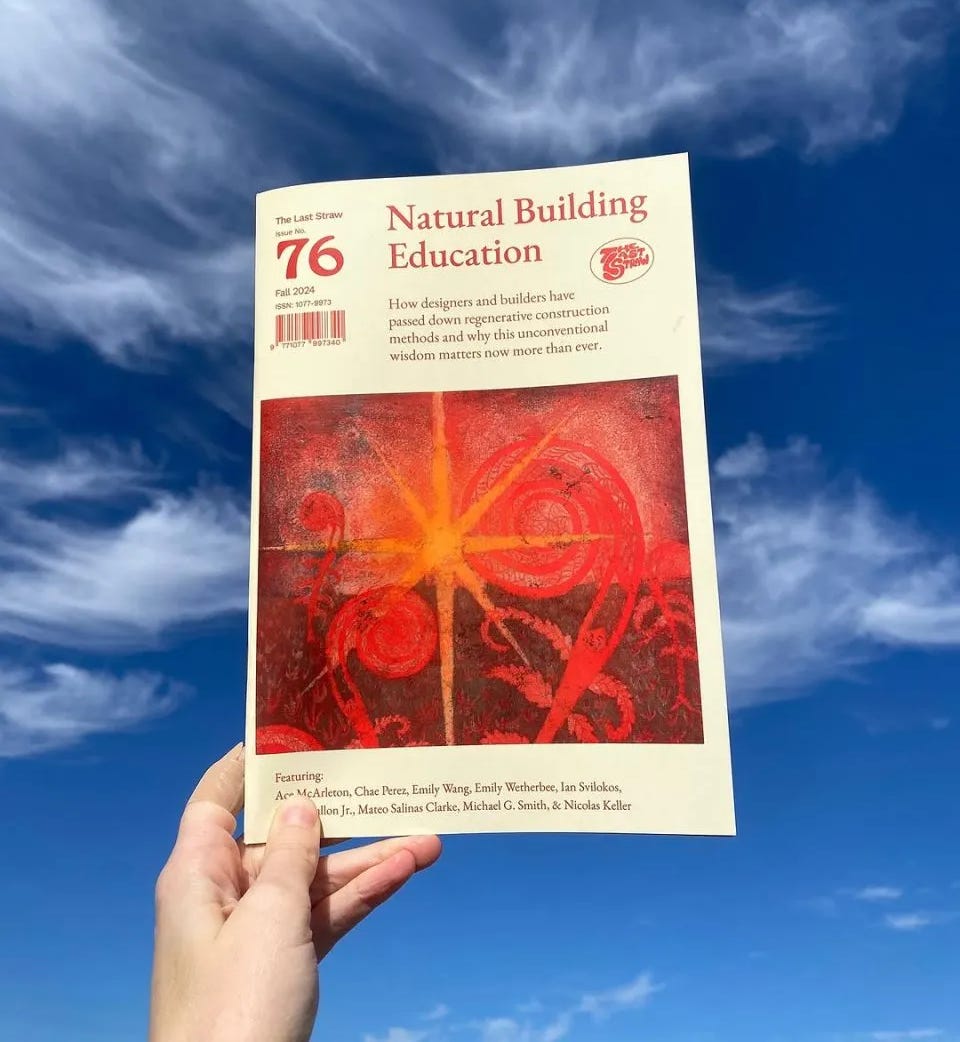
How do you learn natural building? How do you teach it? No one told us the one catch-all trick to natural building education, but in this issue our contributors trace the histories and present to figure out a way ahead.
Thank you to our sponsor:

Its hard to build functional communities, but when it works the effort is so worth it ♥️ Just like our eco village ♥️
https://substack.com/profile/224965082-cecilia-winter/note/c-163424772?utm_source=notes-share-action&r=3pxs62