


July is coming in hot in the U.S.: temperatures are rising and anti-ICE action is still going strong in L.A. and elsewhere even as Congress shovels more money to the secret police. We’re intrigued by the new appropriately-named magazine Heatwave, so maybe add them to your reading list as well. If you’re out on a build site remember to drink water, take breaks in the shade, and catch up on back issues of The Last Straw. And don’t forget - you can still watch a recording of our first TLS Talk (with Ace McArleton, Adrienne Stolwyk, and Greg Bossie) HERE!
FIELD NOTES
New Frameworks co-owner abducted by ICE

New Frameworks co-owner Jose Ignacio “Nacho” De La Cruz was violently abducted by ICE on June 14th, along with his 18 year old stepdaughter, Heidi, who had just graduated high school the week prior. Support them by donating to their GoFundMe campaign, signing a petition for their release, or joining with Migrant Justice of Vermont and the Vermont Freedom Fund to fight against the abductions.
As New Frameworks shows, migrant stuggles are connected to everything else: “according to the National Low Income Housing Coalition, the U.S. must build 1.7 million homes each year through 2030 to meet demand. At the same time, the National Association of Home Builders reports that immigrant workers make up one in every four people in the construction workforce. These realities are deeply connected.” Rebuilding after western wildfires is also slowing.
FIELD NOTES
Federal government stops sharing data that forecasts hurricanes, and Texas government approves fracking wastewater for irrigation

Climate change hits every place differently: some places are getting wetter and stronger storms, others are enduring longer and harder drought. Even our own high desert bureau is under a drought status. These extreme swings have prompted an even more extreme response from the powers-that-be: the U.S. Department of Defense will no longer share data used to forecast hurricanes (although they are still collecting it) and Texas has approved the use of potentially toxic wastewater from fracking for irrigating food crops.
ECO-TECHNICS
Most buildings were designed for an earlier climate, and we need to catch up to the new climatic regime

In this piece, Ran Boydell makes a pretty simple argument for changing the ways buildings are designed and built: the climate is objectively different than it was when most buildings were built (or at least when their design criteria was established), and they are already not working well or falling apart. In other words: do you want climate-adapted buildings, or the current catastrophes to continue? If you’re looking for how to make this happen, then the short, always-relevant book by Bruno Latour, Down to Earth: Politics in the New Climatic Regime, offers some ideas for the “climate realists” among us.
ECO-TECHNICS
Even as Trump seeks an asbestos comeback, bio-based building materials grow

Cancer-causing miracle building material asbestos was never totally banned in the U.S.: a still-thriving cottage industry of lawsuits against suppliers all but eliminated it from use decades ago. Despite this, Trump is hoping to revive its use. While you wait to see if clients will start asking for asbestos, check out these 25 new low carbon materials and the always useful Revalu materials resource website of better materials with arguments for human and planetary health.
LORE
Nonprofit group makes open-source versions of “everyday infrastructure for a new economy”

The Open Systems Lab group are working on open source house designs, mapping types of land ownership, rethinking planning processes, and more. Read more on their general projects page. Take a look at their stuff, and if you’re an altruistic techbro, maybe take some inspiration, or build something with their designs!
RESOURCE
All About: Straw bale construction in the Rocky Mountains

Lindsey Love, of Regenerative Building Solutions, recently gave this presentation about building with straw in the Rocky Mountain region at the National AIA conference in Boston. Throughout 66 slides myths are busted, fire-rating tests are listed, natural building groups are mapped, and building details are highlighted.
EVENTS
July 12-13 Clay Plaster Brown Coat Workshop - Kelseyville, California - Your chance to plaster the interior and exterior walls of a new house with load bearing bales, earthen floors, earth plaster inside and out and *almost* no concrete. For $150 you’ll learn from Amanda Fischer and Myles Danforth of Healthy Home Artisans, and there will be tasks for every skill level and plenty of learning opportunities!
August 2-3 A finish coat workshop for the above project will follow in August.
Stay cool this July and if you ever find yourself near London (U.K.), San Francisco (CA), or Green River (UT) let us know and let’s meet up!
See ya,
The Last Straw Editorial Collective
DON’T MISS OUT, GET OUR LATEST MAGAZINE NOW!
The Last Straw Issue 76, on Natural Building Education
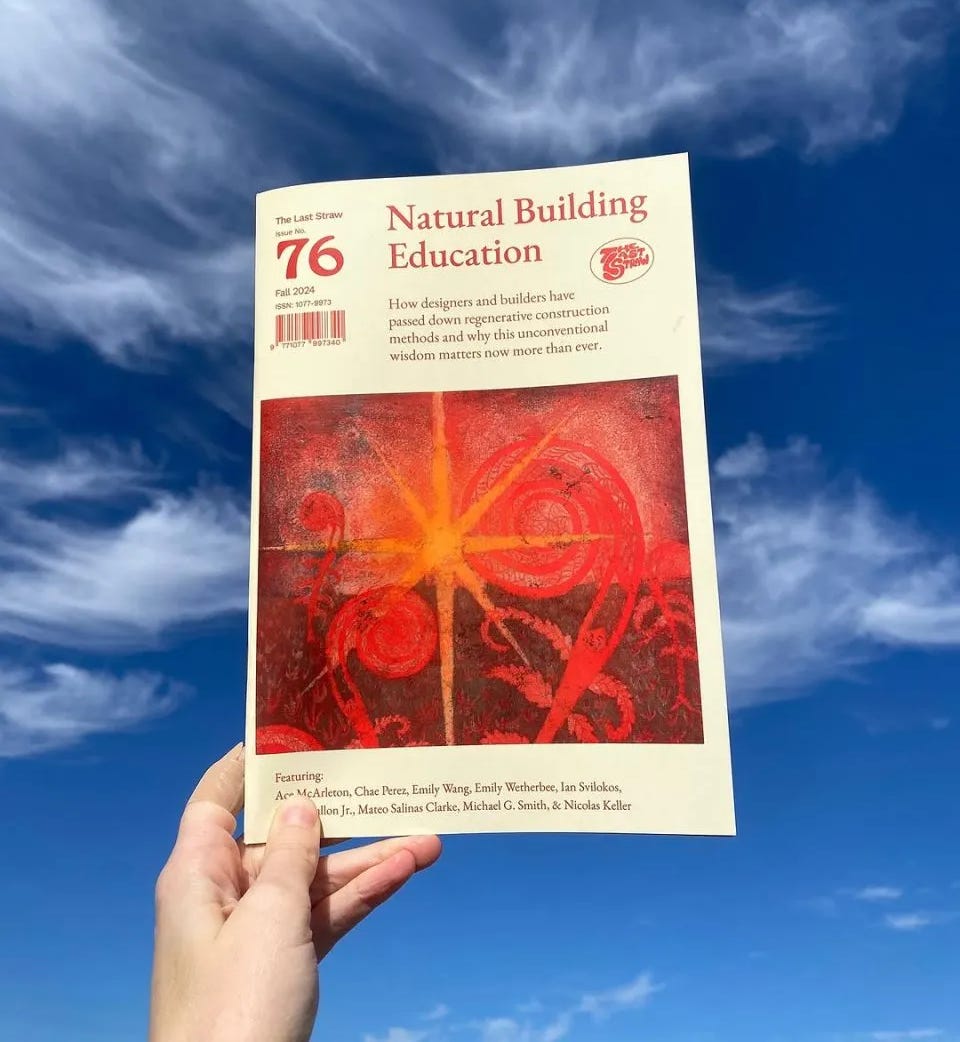
How do you learn natural building? How do you teach it? No one told us the one catch-all trick to natural building education, but in this issue our contributors trace the histories and present to figure out a way ahead.
Nick, it does not look like your comments are related to this post, and at least one of them is copied from your own Substack posts with no context. We don't reference any heat waves as such in this post, but maybe you were set off by the magazine we mentioned called Heatwave, which is itself mainly a reference to an older magazine from the 60's. If you continue to post irrelevant comments devoid of context, we'll remove them, not to suppress or censor, as you seem to imply in your own Substack, but to remove spam comments that unfortunately seem to be more and more common on Internet posts.