


This month, we’re talking about inspiration. Where do we look for new ideas for a project, or for tips on how to incorporate a tricky detail? The world is awash with information but sometimes it’s hard to find the good stuff. If you live somewhere without an established building tradition, it can feel a bit like the omnivore’s dilemma. This past month the news has gotten more dire: the war in Iran has sent oil prices soaring with aftershocks in all corners of the economy, laying bare the perils of fossil fuel dependence. In late February, the Louisiana Offshore Oil Port began spilling thousands of gallons of crude oil into the Gulf, with one fisherman calling the situation worse than the 2010 BP spill. So this month, we have a few ideas of where we can look for building inspiration to get out of this muck: open source building libraries, archival photos, collaborative projects, and creative reuse.
ECO-TECHNICS
An Open Source Library of Construction Details

OpenDetail is a nascent library of open source building info, as part of a collaboration between Henning Larsen, Erhvervsakademi København, and Chevrant. After making an account, scroll around through various details, like a glue-lam to glass interaction, or a green roof connection to a timber facade.
FIELD NOTES
Dive into the Historical American Buildings Survey

For the historians out there, browse through the Library of Congress’ Historic American Buildings Survey/Historic American Engineering Record/Historic American Landscapes Survey (HABS/HAER/HALS). While the site isn’t the most user friendly, it’s a vast repository of building history (apparently, it hosts 451,900 images, so buckle up).
FIELD NOTES
Delicate Demolition in Midcoast Maine

Second Story Builders specializes in the deconstruction of old New England buildings, preserving and reusing as much as they can. The salvaged materials are then used in new construction or sold, creating a circular economy that keeps age-old building traditions alive. A central part of their mission is to create “hands-on learning opportunities for local residents and youth — training the next generation of tradespeople in sustainable building practices.”
FIELD NOTES
Project Feature: École de la Clairière

This timber framed primary school, designed by Tracks Architectes, makes thoughtful use of straw bale and structural cob as central components of its design. Located near Rennes, France, the project was selected by the Breton Bio-Based Federation (FB2) to receive extra support from natural materials experts. It uses site soil in several different applications, including wattle and daub portions, load bearing cob, cob infill, earth and hemp insulation, and plaster finishes. Here’s an inside look.
BIOSPHERICS
Finally: How to Reduce Oil Consumption

Contending for the eyeroll of the month: The IEA recently released a report on “demand-side measures” to cut energy use. Trump’s war on Iran and the closure of the Strait of Hormuz continue to increase oil prices, and this has prompted some to ask radical questions: what if we used less oil in the first place? These solutions include improving EV infrastructure, carpooling, avoiding air travel when possible, reducing highway speeds, and prioritizing public transit. As Lloyd Alter points out, it all feels a bit… familiar, doesn’t it?
FIELD NOTES
Darrell Owens on Transit-Oriented Upzoning in California

SB79 passed in California last year, which permits higher density housing to be built near transit stations. This is an iteration of an early idea for BART (the heavy rail system in the Bay Area), which intended to have corridors of housing along transit lines. This plan was scrapped in the 1960s amidst a wider movement against urban growth, but with this bill’s passing we see a return to the past as a way to move forward.
ECO-TECHNICS
A Giant Leap for Mass Timber

In February, Timberlab broke ground on a 190,000 square foot Cross Laminated Timber (CLT) facility in Oregon. This marks a major milestone in increasing mass timber production in the United States, as so far much of it has come from Europe. The project is a collaboration with Swinerton, LEVER Architects, the USDA Forest Service, Oregon State, the University of Oregon, and the Tall Wood Design Institute.
Stay inspired this month… If you ever find yourself near London (U.K.), Oakland (CA), or Green River (UT) let us know and let’s meet up!
See ya soon,
The Last Straw Editorial Collective
EVENTS
April 10-12 West Coast Natural Building Conference 2026 & Celebration of CASBA’s 30th anniversary! - San Luis Obispo, California
Join us for three days of presentations, discussions, hands-on instruction, community, and celebration; all focused on practicing and scaling natural and bio-based building methods. This year’s keynote speaker is Summer Islam of Material Cultures. Online registration has closed, so contact CASBA for ticket availability.
April 18-19 Straw Bale Stacking Workshop (free) - San Diego, California
We’re ready for one of the most exciting phases of our Ocean Beach ADU project — stacking straw bales! Join us for a hands-on work party where we’ll be stuffing the walls of this handsome little 600SF accessory dwelling unit with this carbon storing, energy efficient, healthy, local, agricultural by-product!
This is a fun, community-powered build day. No prior experience is necessary — we’ll provide guidance, tools, and orientation so everyone feels comfortable. You’ll learn about straw bale building techniques, sustainable construction methods, and gain insight on how natural materials can create beautiful, energy-efficient spaces. The work party will be led by Cat Odell and Erin Emslie of Earth Light Build and long time California Straw Building Association member and Architect, Bob Theis. He helped write the book on building with straw!
Register at https://www.earthlightbuild.com/balepartyregistration
Contact catherine@earthlightbuild.com for more information.
April 24-26 Fibra Clay Plaster Workshop - Berkeley, California
For this workshop, we will be doing clay plaster accent walls directly over plywood shear walls, from start to finish in just 3 days. It will be co-instructed by the manufacturer of this product and co-founder of Gold Hill Clay Plaster, Kyle Alexander, as well as by local natural building professional Darles Eaton. To ensure a high quality of workmanship, this will be a small class size with a high ratio of instruction to participants, so sign up early to reserve your space. This is an ideal workshop for both plaster professionals and plaster dabblers looking to take it to the next level, as well as designers, architects, and contractors who would like to see more natural systems that are appropriate in mainstream contexts. There will also be networking and educational events in the evenings.
Cost: $360
Email darles.eaton@gmail.com for registration or questions about this event.
(ad)
Community Rebuilds is hiring a Construction Supervisor for April 2026. This role leads the on-site construction of six affordable, energy-efficient homes while managing safety, materials, schedules, and subcontractors. Applicants should be able to read blueprints, multitask, and demonstrate strong leadership and organizational skills. The supervisor trains volunteers and supports homeowners in meeting USDA Mutual Self-Help requirements. Moab-based nonprofit. Compensation DOE; housing available. Email your resume to info@communityrebuilds.org
THANK YOU TO OUR CURRENT SPONSORS


DON’T MISS OUT, GET OUR CURRENT ISSUE WHILE ITS HERE!
The Last Straw Issue 76, on Natural Building Education
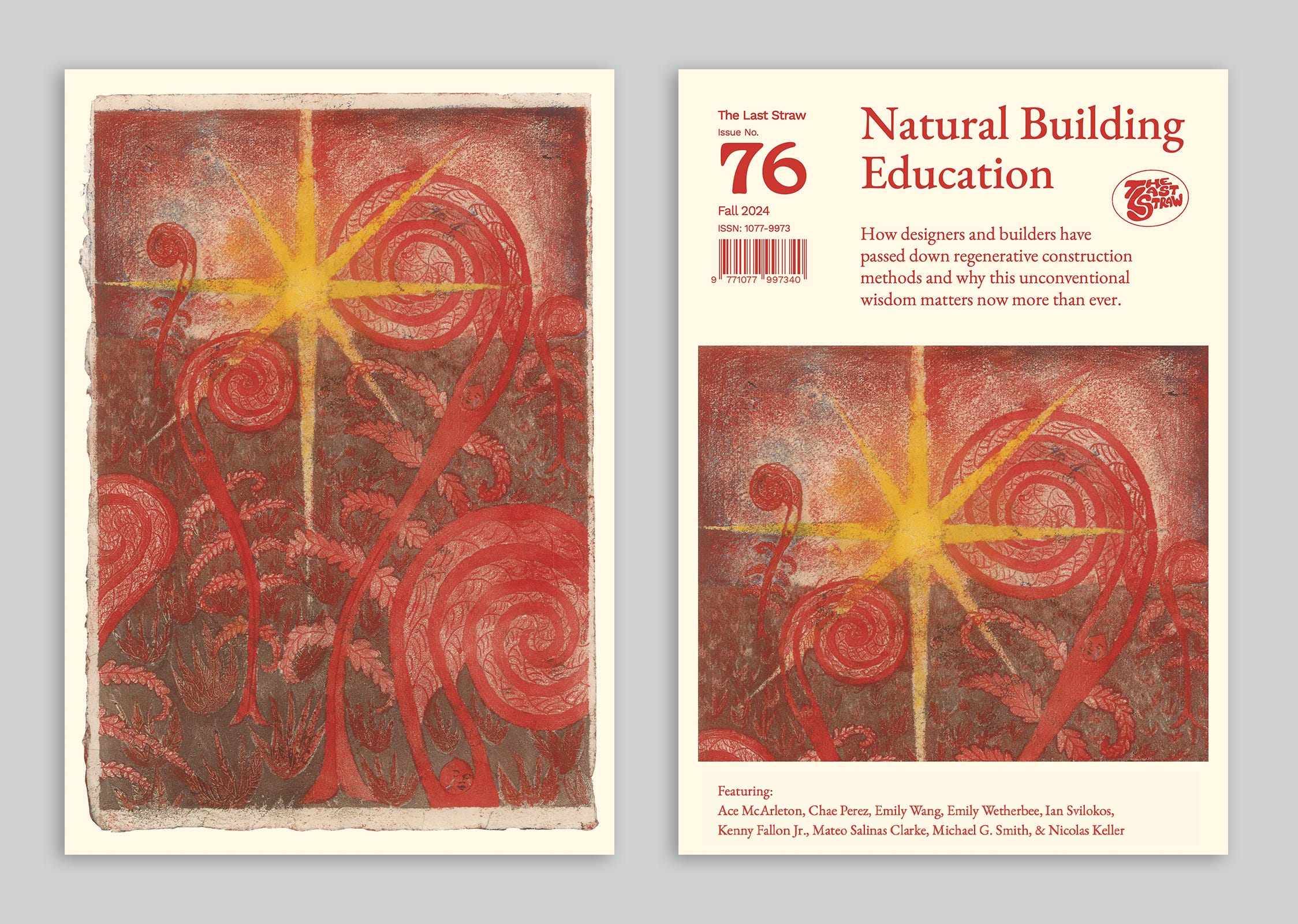
How do you learn natural building? How do you teach it? In this issue our contributors trace the histories and the present of natural building education to figure out a way ahead.