Happy Spring (in the northern hemisphere) from The Last Straw! With all the tumult in the U.S. around drastic changes in environmental remediation funding and policy, we think it’s important to maintain a clear view of our situation: both the severity of the climate crises and also the lesser-known histories that point toward another way. This month we’d like to help clarify a viable future, get the facts, and download Signal.
BIOSPHERICS
Too much of a bad thing: debunking endless growth

You may have heard that a new book called Abundance came out recently, with authors Ezra Klein and Derek Thompson claiming to offer a way out of climate crisis that would be neither uncomfortable nor unpopular. A huge amount of critical reviews came out almost immediately picking apart the book's oversimplifications. Here are a few we've enjoyed reading, that focus on alternative visions:
Malcolm Harris writes in The Baffler that “Abundance is mostly hard to argue with, by design: Klein and Thompson have written a super-partisan sales pitch for a politics of new construction rather than a rigorous, methodical inquiry regarding the causes of national stagnation.” Harris compares this to David Schwartzman’s much more rigorous “solar communism” theory, where political and technological changes clear the way for something better.
The Last Farm’s Substack characterizes Abundance as suggesting that “all of our problems will be solved via deregulation and technology plus a tiny dash of sensible regulation, which will unlock an endless flow of treats powered by magic” and instead offers what The Last Farm calls “library socialism” as the viable path forward.
Lloyd Alter seems just as frustrated as The Last Farm is with the arguments in Abundance. Alter focuses on imagining what might happen if sufficiency would be valued more than endless growth. His vision is kind of uplifting and shares a bit of history too.
BIOSPHERICS
Global soil moisture in ‘permanent’ decline due to climate change

A recent study has found that on a global scale soil is consistently getting worse at retaining moisture. The study also found that dry soil is a more significant cause of sea level rise than previously thought, creating even more ripe conditions for droughts, floods, wildfires, and all sorts of the nasty things awaiting us if we don’t globally change our processes for agriculture, irrigation systems, and material extraction.
FIELD NOTES
The first documented PassivHaus in Uruguay, and it was built with straw!

We just love it don’t we folks? While it’s not technically a certified PassivHaus, Casa AYA is in the International Passive Haus Database, and they only missed the blower door test by 0.06, which is a pass in my book. The team has shared a lot of data about the project and the process at the links above, well worth checking out.
FIELD NOTES
Trump wants states to handle disasters.
States aren’t prepared.

Despite increasingly destructive wildfires, floods, and hurricanes, President Trump is making moves through executive orders to weaken or dismantle the Federal Emergency Management Agency (FEMA). According to NPR, “emergency management experts say Trump's order technically wouldn't do much to shift responsibility. Currently, local and state governments are already in charge of disasters. The question is whether the Trump administration will begin withdrawing the federal resources and funding that states rely on.”
More intense natural events are inspiring some to turn to CalEarth and their fire-resistant SuperAdobe structures, and less reliable government is inpiring others to find each other and come together over the Signal app (which is secure, as long as you are careful and diligent).
ECO-TECHNICS
The front porch: its hidden history and generosity

This excerpt from a forthcoming book explains how the front porch, first seen in southern U.S. architecture, likely originated in Africa. According to author Robell Awake, “enslaved Africans, hailing from similar warm climates, had developed, over centuries, architectural strategies for combating sweltering summer conditions.”
Porches are also getting attention as the focus of the U.S. pavilion at the 2025 Venice Biennale, with 52 groups participating to represent “the United States of America, at its best, in architectural means and in national character”.
Like many Biennales, this edition also harbors some controversy, since Israel decided not to participate for budget and security reasons (for the first time since the 1974 Yom Kippur War), even after the Italian minister of culture rejected a sizable petition to exclude Israel.
ECO-TECHNICS
Video: The BS* + Beer Show: The Benefits of Bio-Based Building Materials

BS and Beer is always some good-natured building science. In these turbulent times, do yourself a favor and watch (or rewatch) this great talk on bio-based materials with some of our favorite boys: Jacob Deva Racusin, Chris Magwood, and David Arkin. And sign up to watch BS + Beer’s webinars each month!
ECOTECHNICS
The Audubon Society is disappointed in LEED v5

The Leadership in Energy and Environmental Design certification, commonly known as LEED, is dropping version 5 this spring, with some genuinely positive changes addressing existing issues with rating system. One update is the addition of a second point for bird safety, which in theory is good, but the additional point splits the existing one point in half, making it possible to claim a bird-safe design with a very bird-dangerous building. This isn’t a new issue for LEED, which is often considered a mostly performative rating system, but the Audubon Society was hoping for more.
We wish you the very best this month, and if you ever find yourself near London (U.K.), San Francisco (California), or Green River (Utah) please let us know and let’s meet up!
With love,
The Last Straw Editorial Collective
DON’T MISS OUT, GET OUR LATEST MAGAZINE NOW!
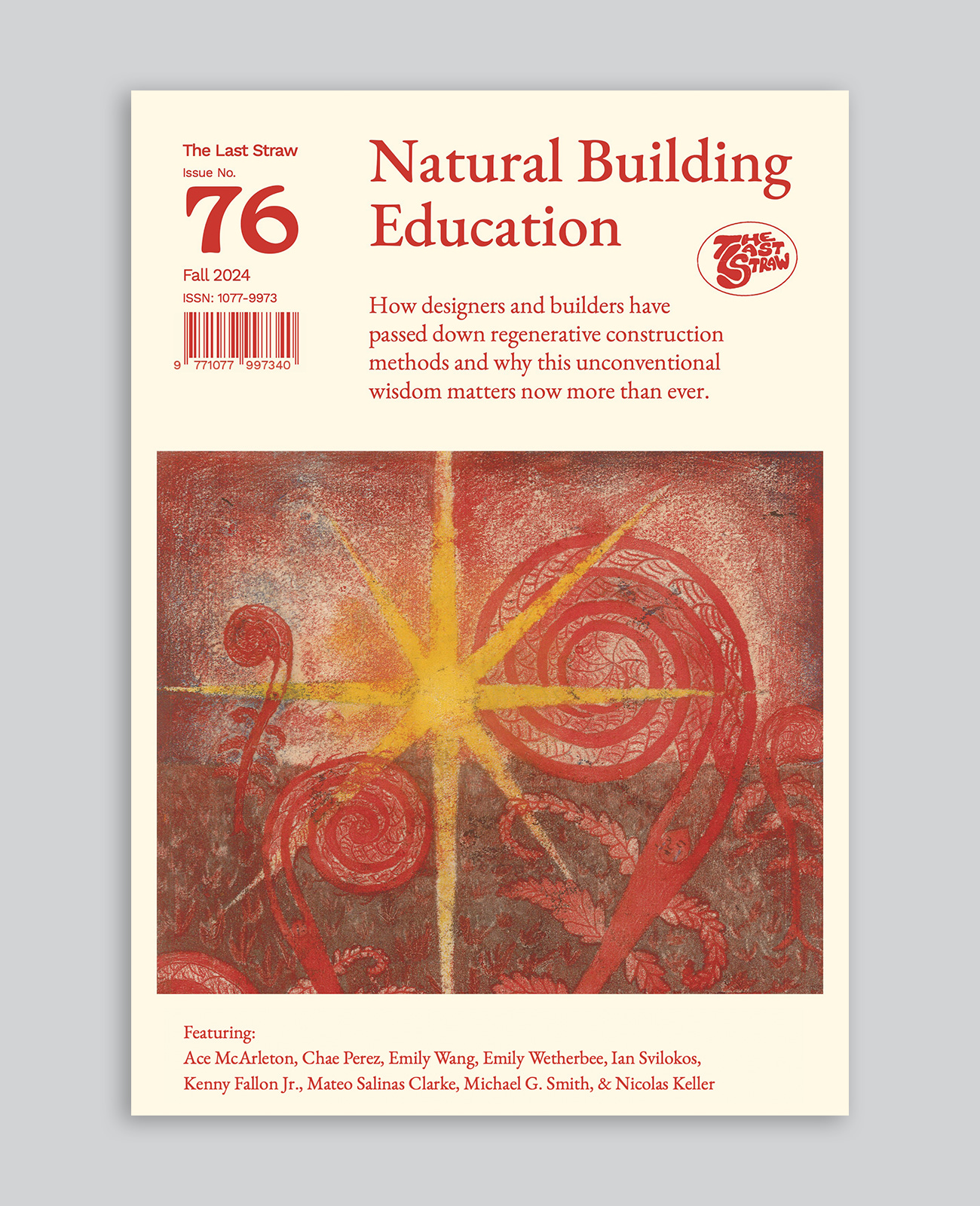
The Last Straw Issue 76,
on Natural Building Education
How do you learn natural building? How do you teach it? In this issue our contributors trace alternate histories and the disparate present to figure out a way ahead for natural building education.